Working as a Yardyman Provider vs. Driving for Uber: Which Pays More?
Driving for Uber or Lyft has become the default answer whenever someone needs extra income. It's easy to understand why — you already have a car, the app is familiar, and you can start immediately. But once the novelty wears off and you do the real math, most rideshare drivers are surprised by how little they actually keep after gas, wear and tear, and platform commissions.
Working as a Yardyman lawn care provider is a different model entirely — and for most people who try both, it wins on almost every dimension that matters: earnings per hour, freedom, client relationships, and long-term growth. Here's an honest, side-by-side look at both options.
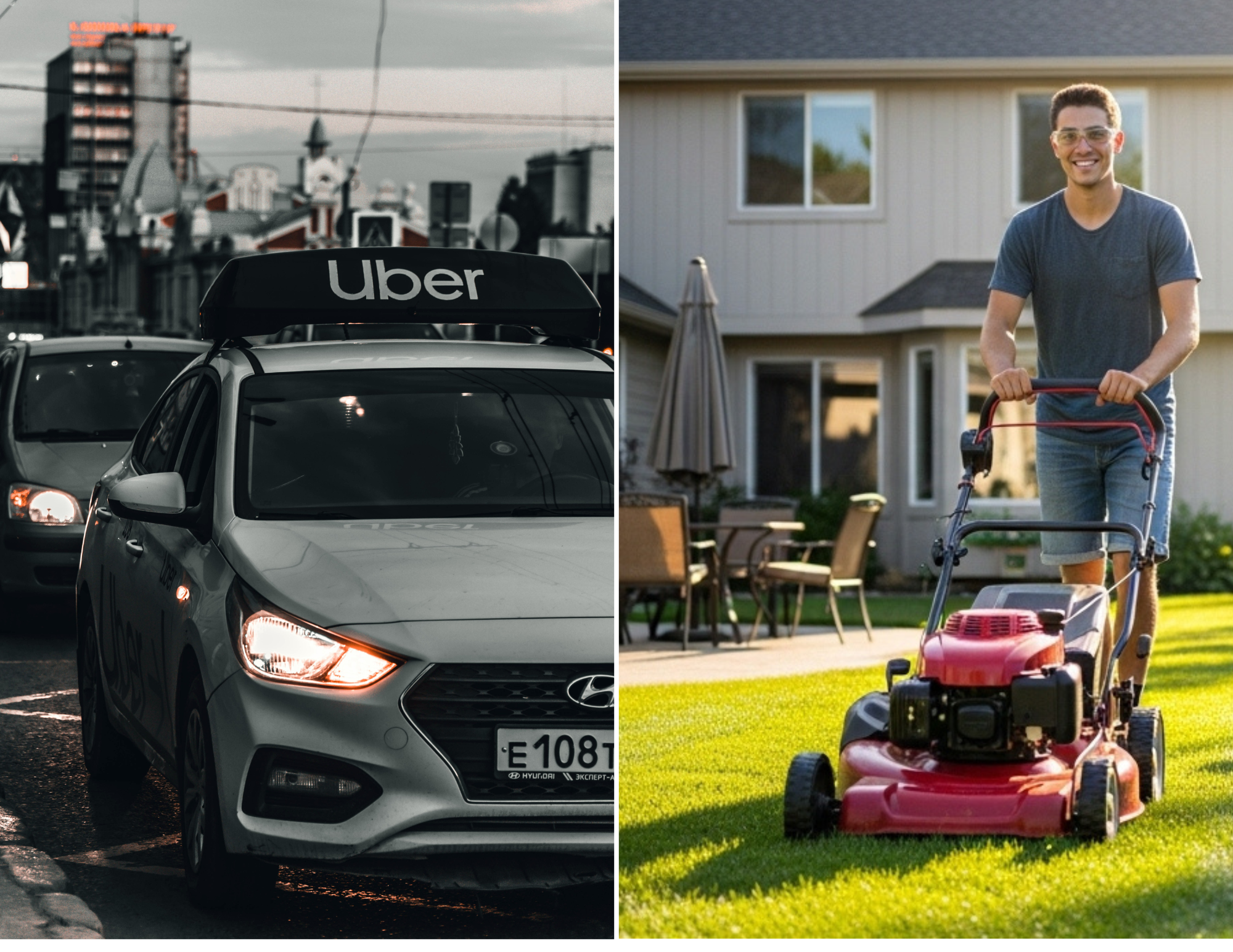
The Commission Problem: What Uber Takes From You
The most important number in any gig economy comparison is the commission. Uber and Lyft typically take between 25% and 30% of every fare — sometimes more during promotions. That means for every $40 ride you complete, you're walking away with $28–$30 before gas, insurance, and vehicle depreciation.
Those costs add up fast. The IRS and CRA both estimate that operating a personal vehicle costs roughly $0.60–$0.70 per kilometer when you factor in fuel, maintenance, and depreciation. On a typical rideshare shift, those costs can easily consume another $15–$25 per hour.
When you add it all up, many Uber drivers in Canada and the US report earning between $10 and $15 per hour net — before taxes. That's not far above minimum wage, and it's coming at the cost of your car's lifespan.
Earnings Comparison: Real Numbers
Let's put actual numbers side by side for a typical Saturday shift:
Uber driver — 6-hour shift
- Gross fares earned: ~$120–$150
- Uber commission (27%): −$35–$40
- Gas and vehicle costs: −$25–$35
- Net earnings: approximately $50–$90
- Effective hourly rate: $8–$15/hr
Yardyman provider — 5-hour shift (4–5 lawns)
- 4 lawns at $55 average: $220
- Yardyman commission: $0
- Gas (local neighborhood driving): ~$5–$10
- Net earnings: approximately $210–$215
- Effective hourly rate: $42–$43/hr
The difference is stark. A Yardyman provider working a shorter shift brings home more than double — sometimes triple — what a rideshare driver earns in a longer one. And the Yardyman provider isn't putting hundreds of kilometers on their car to do it.
You Keep 100% of What You Charge
This is the fundamental difference between Yardyman and every major rideshare or delivery platform: Yardyman does not take a commission.
When you set your rate at $60 for a lawn, you receive $60. When a homeowner pays you $80 for a larger property with edging and trimming, you receive $80. There is no algorithm deducting a percentage, no surge-then-clawback pricing, and no waiting days for a payout transfer.
With Uber, the platform controls your pricing. Surge pricing helps sometimes — but the commission still applies. You have no ability to negotiate your rate with a specific passenger, and you can't reward loyal customers with a preferred rate or build long-term relationships that pay off over time.
The Vehicle Wear Problem
This is the hidden cost that Uber drivers consistently underestimate. Rideshare driving is hard on a vehicle. The constant starting, stopping, idling in traffic, and high mileage accumulation leads to faster brake wear, tire replacement, oil changes, and eventually engine issues. Many drivers don't realize until they try to sell their car that thousands of rideshare kilometers have significantly reduced its value.
As a Yardyman lawn care provider, your vehicle use is minimal by comparison. You drive to a neighborhood, work for several hours on foot, then drive home or to the next nearby property. Most providers work within a small radius and drive only a few kilometers between jobs. Your vehicle stays in far better condition — and holds its value.
Schedule Freedom: Who Really Controls Your Time?
Uber markets itself as the ultimate flexible gig — and in theory, it is. You can log on anytime. But in practice, the best earnings happen during specific surge windows: Friday evenings, Saturday nights, early mornings around airport runs. If you want to earn well, you're somewhat constrained to working when the algorithm rewards it — which often means late nights and weekends in high-traffic periods.
With Yardyman, your schedule is genuinely yours. You decide which days you work. You book clients at times that suit you. You build a recurring schedule that you can plan your life around. Most lawn care providers work Saturday and Sunday mornings — a clean, predictable window that doesn't interfere with evenings or family time.
And because you have regular clients who book in advance, you're not sitting in a parking lot waiting for a ping. You know on Sunday morning that you have four lawns booked — you wake up, show up, do the work, get paid.
Repeat Clients: The Income Advantage Uber Can't Offer
Every Uber trip starts from scratch. You pick up a stranger, complete the ride, and the relationship ends. Tomorrow, that same person might use a different driver. There is no loyalty, no relationship, no compounding value from repeat business.
Lawn care is the opposite. A homeowner who books you once and has a good experience will book you again — every two weeks, for an entire season. One satisfied client can be worth $600–$1,200 in a single summer. And when they refer a neighbor, that neighbor becomes another recurring client.
Over time, a Yardyman provider with 10 loyal repeat clients has a stable, predictable income that grows season over season — without spending anything on marketing. That kind of compounding simply doesn't exist in rideshare work.
Side-by-Side Summary
- Commission taken: Uber 25–30% — Yardyman 0%
- Effective hourly rate: Uber $8–$15/hr net — Yardyman $35–$60/hr net
- Vehicle wear: Uber high (constant driving) — Yardyman low (neighborhood only)
- Repeat income: Uber none (every trip starts over) — Yardyman high (recurring seasonal clients)
- Schedule control: Uber partially (tied to surge windows) — Yardyman fully (you set your calendar)
- Income growth over time: Uber flat — Yardyman compounds through referrals and repeat clients
- Price control: Uber set by algorithm — Yardyman set by you
Who Is Yardyman Best For?
Yardyman works best for people who want a side hustle that pays well without giving away a chunk of every dollar to a platform. If you enjoy working outdoors, don't mind physical work, and want to build something that grows — lawn care is an excellent fit.
You don't need experience. You don't need certification. You don't need a large startup investment. You need a lawnmower, a trimmer, and a profile on Yardyman. From there, the platform connects you with homeowners in your area who are actively looking for someone just like you.
The math is clear. The freedom is real. And unlike rideshare driving, the income you build with Yardyman belongs entirely to you — no commission, no algorithm, no percentage taken off the top.
Ready to grow your business?
Join Yardyman and start connecting with homeowners in your area today.
Become a Provider